In the Artist of the Floating World, the narrator meets with his future son-in law, Jiro Miyake. Jiro expresses to the narrator his relief that the president of his company has committed suicide. Jiro continues to express his discontent that those who were responsible for Japan entering World War II haven’t claimed responsibility and committed suicide themselves. In his conversation to the narrator, Jiro makes it seem like suicide for repentance is common occurrence at this time. I found the willingness and the expectation to own up to your mistakes fascinating. In the United States (or maybe Western cultures in general) it’s rare to see remorse for mistakes. Even rarer is to see people taking responsibilities for those mistakes and trying to rectify them.
Our whole society accepts this behavior as normal. As we’ve seen in recent news, executives are running their companies into the ground, leaving their employees with the financial burden and leaving with millions themselves. We see that most Americans in general have this mentality as well. We buy and consume so many resources. Even though we’re 5% of the population we use 25% of the earth’s resources. And even with significant evidence that global warming is occurring, Americans still refuse to admit that our lifestyle is the cause and that it needs to be changed. This disregard of our actions and its repercussions can conflict and hostility. Other countries are beginning to resent the United States for burning so much fossil fuels, but being restricted by our government to do so themselves. And when these countries can’t burn fossil fuels, the major source of energy, it makes it incredibly difficult for the country to develop.
I think that it’s safe to say that America doesn’t apply the principle norm of social justice, “A social norm stating that we should help only when we believe that others deserve our assistance” or social responsibility, “norm stating that we should help when others are in need and dependent on us”(Glossary). Americans. We are in denial, believing that consequences to our actions don’t affect others, so they don’t deserve help (which would rectify our mistakes). According to the New York Times, at the United Nations Climate Change Conference in Copenhagen, the US envoy blamed the Chinese for their fuel emissions, criticized Europe for making too many demands on the US, and said “the sense of guilt or culpability or reparations, I just categorically reject that.”
This sense of denial and refusing to take responsibilities for our actions is something the United States government and perhaps its citizens participate in everyday. But, like in the case of global warming, our actions can potentially have catastrophic results. Hopefully before any of these catastrophic consequences occur, we will engage in norms (expected standard of behavior and belief established) of social justice and responsibility.
Works Cited:
Broder, John. U.S. Climate Envoy’s Good Cop, Bad Cop Roles. 10 Dec. 2009. The New York Times.10 Dec. 2009. http://www.nytimes.com/2009/12/11/science/earth/11stern.html?_r=1&ref=global-home
Unknown Author. Glossary. University of Richmond. 10 Dec. 2009. https://facultystaff.richmond.edu/~allison/glossary.html
Tuesday, October 6, 2009


Nuclear Ping-Pong
Nuclear Ping-Pong
Nuclear Ping-Pong is the result of playing a game called Rise of Nations up until the modern eras (Microsoft). Invariably the computers will begin bombarding cities with nukes, and invariably the player—who is generally annoyed at that point—will retaliate in kind. Ultimately everything in the game will be destroyed.
Fortunately the game offers an easy solution; simply remove the use of nuclear weaponry from the game. There’s a nice little button that does just that. The real world, however, has no such button, and therefore a method of avoiding ‘nuclear ping-pong’ is necessary. Thankfully this is somewhat easier than in Rise of Nations, since neither the computers, nor the humans playing against them, care about killing virtual people.
For the past forever the theory of deterrence has acted as the limiter on nuclear weaponry. The deterrence on nuclear weapons essentially “seeks to convince adversaries that the benefits of hostile actions would be far outweighed by the consequences” (Corcoran). While this technique managed to dissuade Russia from beginning a nuclear Armageddon, it might not convince everyone, either because they believe that the utilization of a nuke is worth the costs, or because they believe that there won’t actually be a cost.
Three questions should be asked to determine if the world could degenerate into nuclear ping-pong. First, could a terrorist faction or anti-USA country obtain a nuke? Considering that North Korea already—supposedly—has nukes, and is threatening to export them, that could be answered a yes (Allison). Second, would terrorists or extremely anti-USA countries be willing to use a nuclear weapon? Third, would the USA retaliate in kind if provoked?
Looking at 9/11, I would say that terrorists probably would use a nuke if they had one. It wouldn’t be the first time they didn’t factor in long-term repercussions. And looking at the Iraqi war, the USA could be accused of the same.
Hopefully, though, nuclear ping-pong isn’t possible, or if it is, it will never occur. After all, as much as nuclear ping-pong drives me crazy in Rise of Nations, I bet it sucks even more in real life.
Allison, Graham. “No Loose Nukes: Preventing a Terrorist Nuclear Attack on the U.S.”
Corcoran, Edward. “STRATEGIC NUCLEAR WEAPONS AND DETERRENCE.”
Microsoft. Rise of Nations. 2003.
Social Impact and the Will of the People
Propaganda in our day and age is omnipresent. Everywhere you go there are advertisements showing off a product, there are politicians gunning for a seat of power, there are countless news stories that show only one side of a story, and there are many traps that people seem to find themselves falling into because of propaganda. Propaganda is widely known, people know how and why it works and yet people still seem to be suckered in by it. Over time propaganda has proven to be the most obvious yet effective means of persuasion. People are willing to take whatever people throw at them at face value, rarely questioning what they see. Politics are a great example of this "blind faith" about propaganda. During elections political advertisements only show the side of an argument that makes their candidate look good, while making the opposing candidate look as appalling as possible on television. People have become so divided politically that the only two parties that have a chance of getting elected are the Republican and the Democratic parties. Each party shows advertisements, makes promises, creates catchy slogans, and successfully rallies close to an army of supporters for their cause. The people believe so much that their candidate is the right one for the country, and some are even willing to go to extreme lengths to assure their candidates victory. Most of these political claims however turn out to be falsifications, stretches, or downright lies. The politicians are using propaganda to win favor over the hearts and minds of the people. People are aware of how and why propaganda works, the information regarding the strengths and weaknesses of propaganda are readily available but it still works. One psychological explanation for why propaganda works so well is the Social Impact Theory. The Social Impact Theory states that the likelihood that a person will respond to social influences will increase with Strength: how important the influencing group is to you, Immediacy: how close the group are to you, and Number: how many people there are in the influencing group. (changingminds.org) One can easily look at the Social Impact Theory at times of presidential elections. When strength is analyzed the Republican and Democratic parties are incredibly powerful and the most influential political parties in America. If one were to look at immediacy it would be shown that during election years new political commercials are released constantly on television and the internet, so people are hardly given an opportunity to forget about the stressful election for a while. If one were to look at number the Republicans and the Democrats have amassed close to an army of supporters each election and even after wards people are either Republicans or Democrats. With such strong credentials for the Social Impact Theory, it's no wonder that people get caught up in these heated debates over politics. All new forms of propaganda are incessantly released for elections, and people are the most politically active and rallied during the new presidential elections. The ways to counter the Social Impact theory are to reduce the Strength, Immediacy, and Number as much as possible, but in America doing so is impossible. The media is in place to prevent such a reduction, and are always bashing or praising politicians. All one can hope for is that people will take the time to research and think for themselves, and try to see through the propaganda, to see through what may or may not be true.
Sources: http://changingminds.org/explanations/theories/social_impact.htm
Monday, October 5, 2009
Cognitive Dissonance and Propaganda
Cognitive Dissonance and Propaganda
Propaganda and cognitive dissonance go hand in hand when attempting to convince people to think a certain way. Propaganda is influence or suggestion through the manipulation of symbols and the psychology of the individual (Pratkanis 6). Cognitive dissonance is when one holds two opposing beliefs at the same time and wishes to reconcile them and rid oneself of the uncomfortable confusion (Jasper 1). Propaganda plays on this need to have only one view by justifying one argument so that it annuls the other. People want to justify their beliefs so they seek out evidence that supports their beliefs (Smith 1) and propaganda provides a source of information that is simple and straightforward making it easy for people to justify their own beliefs or their conflicting beliefs.
For example in Nazi Germany a citizen may have two beliefs: It is wrong to imprison innocent people and the Government is always right and has the citizen’s best interests at heart. However these two beliefs are in opposition because the Government (who is always right) is imprisoning Jews (who are innocent). These conflicting beliefs cause the citizen to experience cognitive dissonance which will make him uneasy. Therefore he will go out looking for information that will reconcile his beliefs. This is where propaganda comes in to play. Propaganda is simple, straightforward, and persuasive. If our citizen sees anti-Semitic propaganda that portrays Jews as criminals and the source of the country’s vast social and economic problems then that reconciles their beliefs: Jews are not innocent they are criminals therefore the government is right to imprison them. Then the citizen will ignore any further evidence there might be that points towards the innocence of Jews or flaws in the government because that would create cognitive dissonance again.
In the above example it is easy to see how governments could manipulate their citizens to go to war. Most governments try to foster a sense of nationalism in their people so when it comes to a conflict they can be manipulated by being labeled “unpatriotic”. When a person is labeled as “sexist” or “unpatriotic” when they don’t conceive themselves to be then this creates a state of cognitive dissonance (Jasper 1). This causes them to try “to prove to themselves and others that they are not sexist” (Jasper 1) or unpatriotic by becoming very patriotic or anti-sexist to try to unite the two beliefs (Jasper 1). People are confused when their idea of themselves is different from the way the world sees them. Either they change the way they look at themselves and accept society’s view or they change how others see them. Since most people consider being “unpatriotic” or “sexist” as negative they choose not to accept that label and instead change their ways so as to appear anti-sexist or patriotic. In this way countries can get the most adamant dissenters to support war efforts by accusing them of not loving their country and being unpatriotic. They use propaganda to paint a picture of a “patriotic” person: someone who supports the government and is active in the war effort. In contrast an “unpatriotic” person speaks against the war and the government. They are shown as damaging the country and even helping the enemy. When someone is given a negative label and (when they believe they deserve the positive one) they try to get rid of it by becoming more like the positive label.
An example of this is President Bush, Jr. and the wars in Iraq and Afghanistan. The 9/11 attack had everyone in a patriotic frenzy and they preyed on that, labeling anyone against the war as “unpatriotic”. During this time everyone considered themselves a “patriot” and when they were told they weren’t one they changed their ways to fit the propagandized version of one. This just goes to show that the military or the government will always be able to manipulate people into supporting a war. This doesn’t mean war is inevitable just that no matter how unpopular a war is that there will always be supporters.
Cognitive Dissonance can be used to garner support for conflict within a country due to propaganda. However, it is possible that enough people will see through the propaganda that a war will not happen. Citizens must learn to try to find out the facts for themselves and make informative decisions instead of letting the awkwardness of having conflicting ideas drive them to seek the simple solution of propaganda.
Works Cited
Jasper, John D., Mary Prothero, and Stephen D. Christman. "I’m Not Sexist!!! Cognitive Dissonance and the Differing Cries of Mixed- and Strong-Handers." Personality and Individual Differences 47.4 (2009): 268-72. Print.
Pratkanis, Anthony R., and Elliot Aronson. Age of Propaganda: The Everyday Use and Abuse of Persuasion. New York: W.H. Freeman, 1992.
Smith, Steven, Leandre R. Fabrigar, and Meghan E. Norris. "Reflecting on Six Decades of Selective Exposure Research: Progress, Challenges, and Opportunities." Social and Personality Psychology Compass 2 (2008): 464-93. psycinfo-set-c. Web.
Racism and American Aggression
(Part 1: The "Inevitability" of War)-(Part 2: Racism)-(Part 3: Implict Association)-(Part 4: National Identity)-(Part 5: Multiculturalism)
Even in our post-Civil Rights era, racism and intolerance play a significant role in determining whether or not the United States goes to war. After the destruction of the World Trade Center, anti-Arab and Muslim sentiment had notably grown leading to discrimination, unconstitutional surveillance, and, ultimately, war. The media, a primary dispenser of such stereotypes, is also responsible for instilling a cynical view of other people within the American masses.
September 11, 2001, marked a drastic change in the attitudes of many Americans towards Arabs and Muslims. In his article, “When You Look Like the Enemy”, sociologist Cliff Akiyama notes the disturbing parallels between the racism of Japanese Americans after the attack on Pearl Harbor, and the racism towards Arabs after the World Trade Center fell (210). And, with the Patriot Act in effect, the US government has little to no restraint when it comes to infringing on the civil rights of Americans that the government deems to be a threat. And, of course, citizens of Arab origin are most likely to be singled out for surveillance. The Patriot Act is significantly harsher on foreign suspects that are not America citizens as it can give way to the use of detention, torture, and deportation if some arbitrarily determined definition of a terrorist threat is met (211). The passage of this act only served to further aggravate the tensions between the US and the Arab community, factoring into the poorly planned assault of Iraq. Furthermore, the Patriot Act allowed for additional civil rights infringements such as the Abu Griab prison scandal and the Guantanamo Bay torture controversy.
A Gallup poll published on August 10, 2006, seems to indicate that a lingering minority of US citizens still hold alarmingly racist sentiments towards their Muslim neighbors. Thirty-four percent of US adults polled made the hasty generalization of assuming that most American Muslims were “sympathetic to the al-Qaeda terrorist organization” (Gallup). Additionally, thirty-nine percent of US adults polled favored requiring “Muslims to carry a special ID” (Gallup). These results, obtained by 1,007 adults selected at random across the nation, would seem to indicate that Islamophobia and racism towards Arabs inspired by the tragic event of 9/11 still linger (Gallup). Addressing this issue is important if America has a true desire to help restore peace and stability to the Middle East.
The extensive coverage of the nationality of the 9/11 terrorists has had a significant effect in promoting American aggression against Arabs. Research conducted by George Gerbner, a communications professor, indicates that the media is a significant source of the stereotypical views of most Americans. After having witnessed countless acts of violence, betrayal, and hate on television, most heavy television watchers naturally view the actions of other people with suspicion (Pratkanis 82). Since conflict and war naturally feed upon such suspicion, the media-addicted masses are much more prone to war propaganda stressing how foreign nations cannot be trusted. And, as Cliff Akiyama’s analysis has shown, this suspicion extends to those who are ethnically similar to the enemy.
Resolving these negative stereotypes is largely dependent upon the intelligence and open-mindedness of the masses, especially in times of crisis. The assumption that other people cannot be trusted, which is heavily promoted by the media, is partially responsible for the belief that war is inevitable. Such a view runs counter to the multicultural solution of effectively dispelling racially charged propaganda and viewing issues with an open and tolerant mind.
Works Cited
Cliff, Akiyama. “When you look like the enemy.” Brief Treatment and Crisis Intervention. 8.2 (2008): 209-213. Print.
Saad, Lydia. “Anti-Muslim Sentiments.” Gallup.com. Gallup. 10 Aug. 2006. Web. 5 Oct. 2009.
Pratkanis, Anthonoy and Elliot Aronson. Age of Propaganda: The Everyday Use and Abuse of Persuasion. New York: Henry Holt, 2001.
No! Not the children!
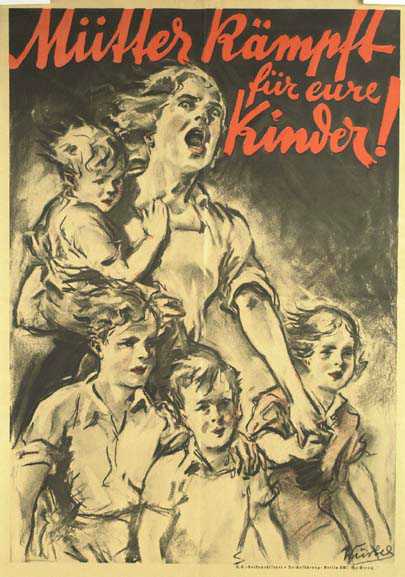 "Mothers! Fight for your children!"
What kind of mother would deny the safety of her children? Of course, no loving mother would neglect to do so, but this Nazi poster almost forces you to take action and do something. It intentionally exploits on the fact that a parent has this natural dedication, or rather this instinct, to ensure the survival of their offspring.
Oddly enough, there is no immediate threat to the children; Nazi propagandists are simply manipulating this 'drive-to-protect' for their own ulterior motives. Appealing to such a strong emotion, it's no wonder why Hitler was able to slay millions of Jews, or "enemies."
Propaganda has this horribly negative connotative meaning, but in theory, it could be used for the betterment of society and its people. However, the way in which it is interpreted is entirely subjective. Complimentary to that, the inferences from opposing parties are nearly guaranteed to be opposites.
Take for instance this poster from World War II: being an American, you are probably somewhat disgusted at the underlying purpose of this propaganda. Yet, if you were a German civilian at the time, you might have felt a sense of courage and nationalism. With the former, you retain this widely-accepted, negative meaning of the word propaganda, and with the latter, you experience this new-found, positive propaganda, that drives you to preserve and protect your own kind. So, am I saying that the Germany's actions were justified in the Holocaust and in World War II? No, I'm simply stating that the emotions invoked from the use of propaganda can cause for one to feel like what he/she is doing is right, but what is right and what feels right are two different things.
Bytwerk, Randall. "German Propaganda Archive." Calvin College. Mar. 2001. Web. 05 Oct. 2009.
The World in "Conflict"
The World in “Conflict”
Unfortunately, whereas smaller conflicts such as the two children arguing are dealt with on a personal-involvement scale, much larger conflicts brew among nations that cause conflict for the lives of millions. Yet, differentiating between such small, domestic conflicts vs. large, national conflicts used to be quite simple. Now there are names and levels for all sorts of issues and conflicts that arise. Now it is no longer “a personal issue” or a war. Now vocabulary such as “domestic disputes,” “abuse,” “uprising,” “civil disturbance,” “insurgency,” “low-intensity conflicts,” “high-intensity conflicts,” and of course, “war” are used to describe conflicts.
“In psychology, a struggle resulting from incompatible or opposing needs, drives, wishes, or demands. Interpersonal conflict represents such a struggle between two or more people, while internal conflict is a mental struggle” (“conflict”).
Now, this is a simple demonstration of the basic idea of conflict, when two ideas oppose each other either between people, or in ones own psyche. "The emphasis on conflict within societies is certainly in keeping with general evolutionary considerations, since, in the absence of genetic identity, all organisms have conflicts of interest. Therefore, it is not surprising that people may have conflicts of interest over the construction of culture" (MacDonald). This states nicely that before we even get to the bigger conflicts such as war, we have conflict in the basic genetic makeup of human beings. Then why do we get to such huge conflicts as war? And how do we label, or differentiate between the basic conflict and the extreme conflict?
Neither the government or the media, that are supposed to keep us so informed, make it any easier. Currently there is much debate in the US government administration about how to handle the ongoing "conflict" in Afghanistan. Within 3 sentences, the issue changes from conflict to war. "The question of whether to further escalate the conflict after adding 21,000 U.S. troops earlier this year is a major decision facing Obama and senior administration policy advisers this week....Divided on Afghanistan, Congress takes up a massive defense spending bill this week even before the president settles on a direction for the war" (Gearan). Most Americans forgot about the "war" in Afghanistan as Iraq became a more prevalent problem and the death toll in Afghanistan dropped - until recently. Now the conflict has become enough of an issue to raise interest in the American society and the government to consider it a full-fledged war, despite the hesitation the government feels in getting even more engaged in it (Gearan).
"The United Nations defines "major wars" as military conflicts inflicting 1,000 battlefield deaths per year. In 1965, there were 10 major wars under way. As of mid-2005, there were eight Major Wars under way [down from 15 at the end of 2003], with as many as two dozen "lesser" conflicts ongoing with varying degrees of intensity" (The World at War). With these parameters, half of the deaths caused by any sort of conflict are not even taken into consideration. "During World War I, civilians made up fewer than 5 percent of all casualties. Today, 75 percent or more of those killed or wounded in wars are non-combatants" (The World at War).
What these definitions of conflict forget to consider are the over-all effects of any sort of conflict. It doesn't just effect those carrying the weapons or making the administrative decisions about how much effort should be put into the battle. When any sort of conflict arises, the issue filters down to the surrounding community and people, and hundreds - thousands - of lives are lost. It is not fair to put a definitive label on "conflict" and "war" by how many people die, because more people than are even considered die due to the conflict at hand.
Works Cited
"conflict." Encyclopædia Britannica. 2009. Encyclopædia Britannica Online. 05 Oct. 2009
Gearan, Anne. "Obama to confer with lawmakers on Afghanistan - Yahoo! News." Yahoo! News. Associated Press, 05 Oct. 2009. Web. 06 Oct. 2009. .
MacDonald, Kevin. "Conflict Theory of Culture." Evolutionary Psychology 7.2 (2009): 208-33. Abstract. Conflict Theory of Culture 7.2 (2009): 208-33. Print.
The World at War. GlobalSecurity.org, 12 July 2009. Web. 02 Oct. 2009.
Subscribe to:
Posts (Atom)